
General
 Although the European market (within EMEA) is the second biggest potential market by size (potential of 450 million consumers) and the second by maturity of the market (the USA is at this moment still number one), the distinct differences between the nations remain. The many languages, the different cultures, the legislation per country and the various believes are all important aspects in daily work, hobbies and spare time to consider when approaching the business in each country of Europe.
When addressing the European markets these local aspects need to be taken into account if a vendor wants to move into the European market.
Although English is becoming the preferred business language, in most cases it is not the obvious language to address people (native language for only 18% of Europeans). Within the European Union (27 countries) 23 languages are spoken and most business deals and contracts are very often in the native language. This makes entering European markets for most non-European - and even European - companies a difficult task.
Europe is a very opportunistic and growth market, but is a ‘small world’ where personal contact, the local native language and adhering to local customs and behavior are very much part of the business relationship. Europeans still prefer to have a contact ‘around the corner’ rather than having to make long distance phone calls taking into account the different time zones, languages and business habits. Approaching companies from within Europe leads to increased acceptance, trust and stimulates setting up partnerships. This is critical in building strong relationships and associated customer confidence; and is key in any sales process in EMEA.
Doing Business in EMEA top
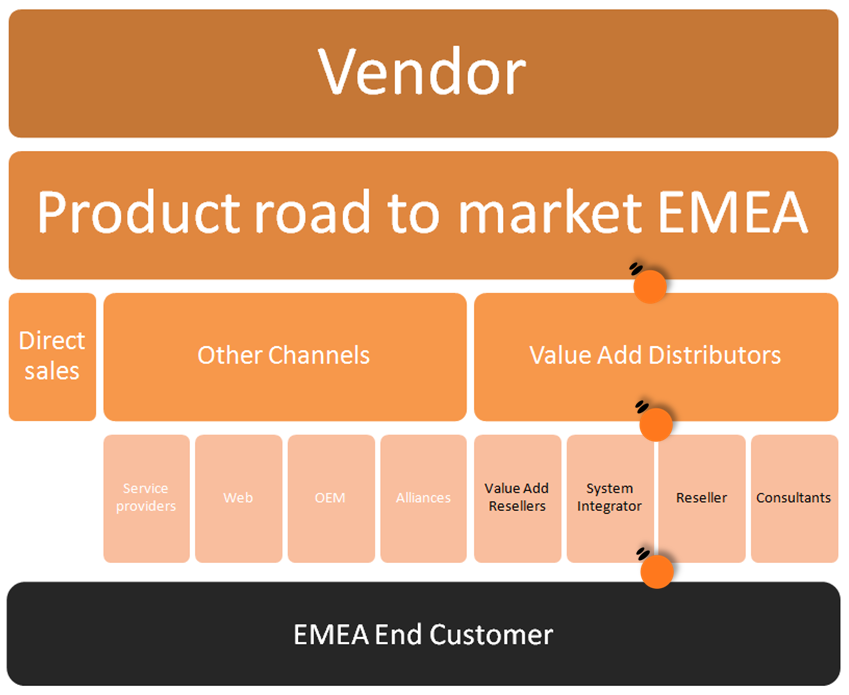 The business environment in the EMEA region has some important differences to that experienced in other markets. The sales cycle is typically longer, partly as a result of major purchasing decisions being made centrally, often at board level, and partly due to the way the road to market is structured in EMEA, everything (90%) of all business is funneled via a two or hree tiered model (Distributor, Reselling partner, End Customer).
The Reselling partner is hereby being perceived as the trusted advisor to the end customers, this could be a bigger or smaller organization, all that matters is being the “subject matter expert”. The Value Add Distributors (VAD) in EMEA are unique and totally different from any distributor in the USA market. In EMEA these VAD’s will take the investments in technical training, marketing and proactive sales for the product lines they carry, towards their reselling partners and often towards end customers too. In a way, they represent themselves as the vendor for their local perspective market (which is often only one of the countries in EMEA).
In EMEA, one should consider that the high end IT technology markets are not those of the end customer, but rather of the partners that can bring the product to market. This provides the highest possible leverage, but does requires more work to secure a significant company as partner.
Entering the Market top
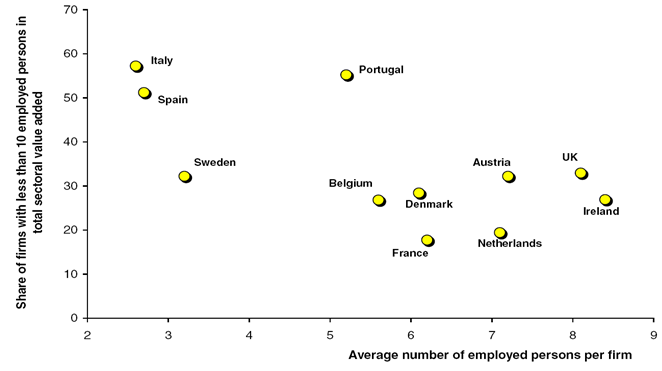 The European countries are typically a small-firm business with the average number of employed persons well below ten. The figure however also shows that the share of firms with less than ten employed persons ranges between 17 and 57 per cent of total value added. This indicates that there can be large differences between countries in the firm size-distribution. While the majority of the targeted prospected end-customers will reside in the Enterprise market, make no mistake that the enterprise market in Europe is in average classified between 500-5000 headcounts companies. To reach these customers, a channel of active reselling partners is a must. There are multiple channels available to enter the market, picking the right partners will be key to your success.

Useful resources :
 EuroPages
The European business directory with 500,000 companies selected in 30 European countriesThe CIA World Factbook
An excellent source of economic, demographic, and political information on more than 250 countries and other entities. The site is updated periodically, with a major update every yearCountry Reports from The Economist
European UnionThe official site of the European Union
European Patent OfficeOfficial website for the European Patent Office, including a search capability.
Doing Business in the EU market
Country Commercial Guides contain information on the business and economic situation of foreign countries and the political climate.
Market research library, US commercial services Access the U.S. Commercial Service containing more than 100,000 industry and country-specific market reports.
EU’s “One Stop Internet Shop for Business” (EU funds, technical standards, intellectual Property law, and more)