Oil, Silver, and Gold are stronger than the Weak Dollar
Can you hear the music? (published 5/30/08)
To paraphrase a song, the hills are alive with the sounds of pundits shouting that the price of crude oil is up, up, and away primarily because the dollar is way down upon the Suwannee River. Well, this Optimist wants to sing a slightly different refrain.
Obviously, the price of crude oil is higher than a kite in flight, and at the same time, the dollar is humming the tune to the MASH theme song suicide is painless, but that does not demonstrate that crude oil strength is equal to dollar weakness. The essential question is whether the price of crude oil is pumped up more by supply and demand fundamentals, or is it elevated more by the depressed dollar that it is priced in.
You can do this with hard work . . .
So how can you separate the value of crude oil from the exchange rate of the dollar that it is priced in? The hard way would be to track crude oil priced in each of the major world currencies (along with the respective GDP per capita, inflation rates, supply and demand data, etc. for each nation), and then to combine all of that information into a consolidated algorithm that crunches the data and produces a single world wide value for each point in time. All of that hard work will be a good exercise for the readers. I prefer to look for simple shortcuts wherever I can find them, and there is a great shortcut I can "borrow" from that guy who calls himself an optimist.
. . . but I prefer the easy way to track the value of oil
 Gold and silver presents an easy way to track changes in the rising real value of gold and silver over time, independently of the exchange rate of the U.S. dollar. The basic idea is to multiply the dollar price of gold or silver times the USDX trade weighted dollar. If the dollar price of gold or silver goes up (or down) by the same percentage that the USDX dollar goes down (or up), then the product will be essentially flat, and that will show that there has been little change in the real value of either gold or silver. I call those two products the MoreAu Index and the MoreAg Index because they filter out the changing level of the USDX dollar, and directly show whether changing prices of gold and silver are caused more by changes in the value of the gold and silver, or are just reflections of currency exchange movements.
Isn't this about oil?
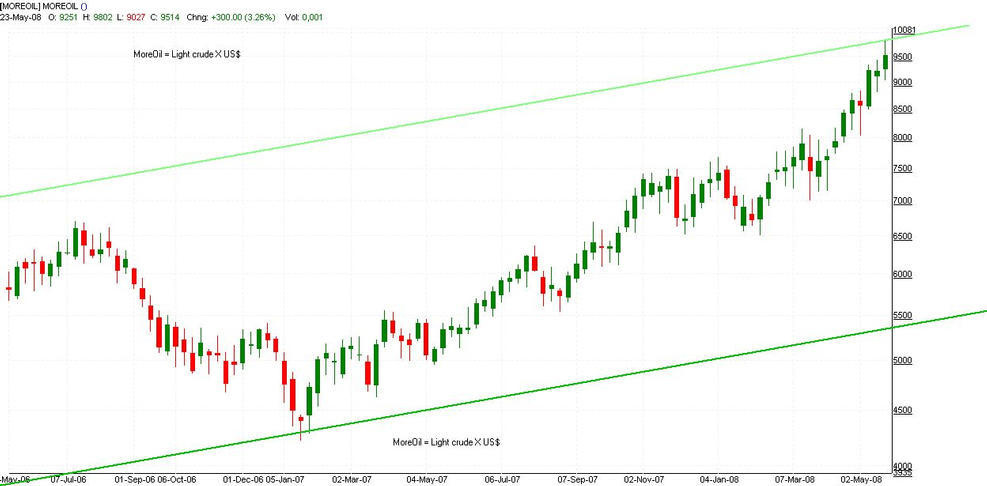
So what would happen if we apply that same approach to crude oil? Well, if the price of crude oil is rising primarily because the dollar exchange rate is dropping, I would expect to see the MoreOil index (the product of the two) to show not much change over time. The actual result, however, is significantly different than that guess. The chart below shows the monthly bars of Light Crude Oil multiplied (high X high, low X low, etc.) by the monthly bars of the USDX dollar since April 1999 (which is as far back as my data source for Light Crude Oil extends).
Charts of changing value of Light Crude Oil excluding exchange rate variations